AI is Crumbling the Traditional Career Ladder—Here's How Ambitious Young Workers Can Build Their Own
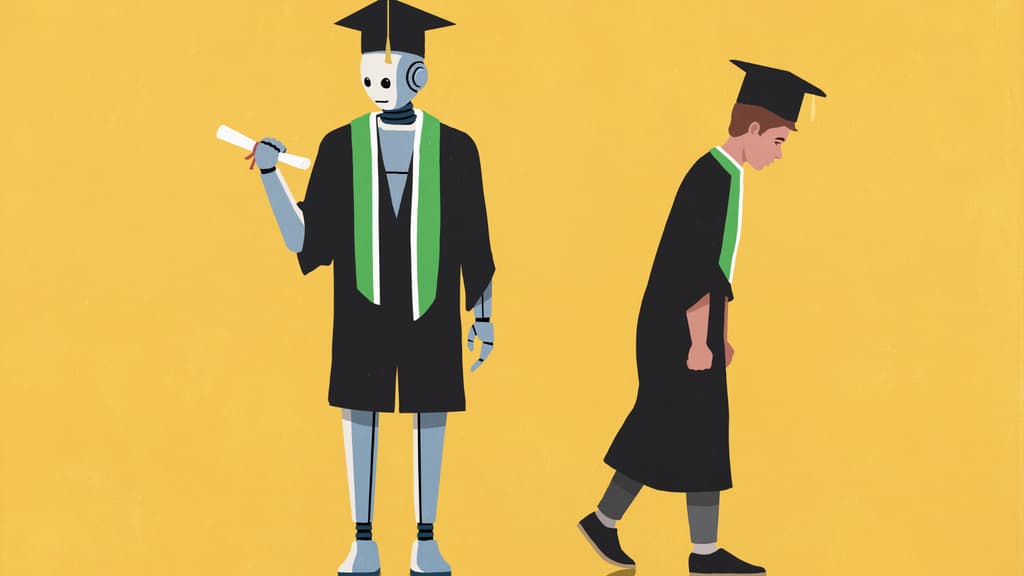
The first rung of the white-collar career ladder has historically been the entry-level job: the messy first draft, the customer question you're not ready to answer, the meeting where you mostly listen and scribble notes. That's where young workers learned what good judgment sounds like. But AI is starting to crack that first rung, and the impact is already visible in tech.
Software developers aged 22 to 25 have seen nearly a 20% employment decline from its 2022 peak. That's a clear signal that the work that used to help young people get in the door—drafting, research, QA, analysis, customer support, first-pass code—is being compressed by AI. These tasks were given to junior workers because they were low-stakes, repeatable, and teachable. Now, AI can handle much of it.
The Apprenticeship Problem
Companies are under pressure to move faster and use AI to operate more efficiently. But there's a hidden cost: judgment is built through reps. You make a recommendation and find out why it was wrong. You write something, get it redlined into oblivion, and learn what "good" means. AI can manage the work, but it can't give a 22-year-old the scar tissue that comes from getting something wrong in front of a customer.
If AI makes large companies more efficient while shrinking entry points for young workers, opportunity concentrates. Those already inside the system get more leverage; those outside have fewer entryways.
A Different Future
But that's not the only possible future. The same AI that's weakening traditional entry-level paths is also giving individuals access to company-building infrastructure that used to require full teams and significant capital. A single founder can now use AI tools to write and review code, design interfaces, build landing pages, run customer research, create content, and automate support. What once required a small cross-functional team can now be orchestrated by one highly capable founder—for roughly $3,000 to $8,000 a year (or about $12,000 for a small team).
AI-native startups can generate many times more revenue per employee than traditional SaaS companies. Solo-founded companies now represent more than one-third of new U.S. startups. This doesn't mean everyone should become a founder—it's hard, gritty work, and most companies fail. But AI does change who can credibly start a company.
4 Founder Profiles Emerging
Some of the brightest young people may prove themselves as builders instead of as junior employees. Investors will want to know: What have you built? How fast do you learn? Can you use tools across domains? Here are four profiles I see emerging:
- The Permissionless Builder: Already shipping apps, GitHub repos, or small online businesses before anyone grants them a job title. They have proof of work, not just a clean résumé.
- The Cross-Functional Orchestrator: Can talk to a customer, build the first version, figure out distribution, and know when the system is unraveling. AI rewards those who can connect functions.
- The Domain-Native Problem Spotter: Close to a painful industry problem, they know why the obvious solution never worked. With AI, they can prototype around the problem without a full team.
- The Self-Taught Operator: Learns through tools, feedback loops, and failed attempts. The advantage goes to those who can teach themselves the next workflow before it becomes a job requirement.
These are the people I'd bet on. They have AI-native workflows, think in systems, experiment quickly, and have a history of building things before anyone asked them to.
Build a Different Career Ladder
Founders have always done things that look unreasonable: flying across the country for one customer, building the ugly first version, sending the awkward email, getting told no and finding another way in. AI doesn't change that part of company-building, but the builder becomes more leveraged once they decide to move.
The conversation about AI and young workers should include creation as well as displacement. If AI produces enormous productivity gains, will those gains sit inside a few large institutions or spread through a rising generation of AI-native builders? The first rung of the old career ladder is crumbling. We can spend the next decade trying to preserve it, or we can build new ways for young people to learn, create, and own the value they produce.
The next career ladder may be built by the people who never got a clean shot at the old one.
- #ai
- #careerdevelopment
- #entry-leveljobs
- #solofounders
- #futureofwork
Comments · 0