AI vs. College Grads: Why Entry-Level Jobs Are Vanishing and How to Fight Back

Marquette University senior Gigi Martin calls the current job market "rejection therapy." She is numb to hearing no after applying to more than 100 jobs over the past year, mostly in the tech industry, and getting a polite denial or no response from about 90% of employers.
"A lot of it has felt like shouting into the void," said Martin, who is graduating this spring with a double major in computational mathematics and history. "It's definitely frustrating."
Martin and others in the class of 2026 looking to enter the workforce in the coming months are up against a tight job market. The recent college graduate unemployment rate has ticked up, and a 2025 report by Oxford Economics said there are signs of entry-level positions being displaced by artificial intelligence at higher rates.
With commencement looming, Martin is pursuing a different path: graduate school for records management and archival studies. Her interest stems from her secondary history major, which she added her sophomore year because she loved the classes and the way the discipline encouraged her to ask deeper questions.
"I have complicated feelings about AI: I recognize the efficiency it can bring, but it has limited my job opportunities," Martin said. "The barrier to get into tech is much higher. They expect you to have all of these qualifications and experience. That's not what an entry-level job is about. It’s to gain experience."
14% of companies surveyed are discussing replacing entry-level jobs with AI
In an economy increasingly reliant on automation, it's a tough time for recent college graduates.
This group's unemployment rate outpaces most other groups, the Federal Reserve reported. The underemployment rate – defined as a college graduate working in a job that typically does not require a college degree – rose to 42.5%, its highest level since 2020.
The National Association of Colleges and Employers, a national organization that tracks and forecasts employment of college graduates, surveys employers twice a year on their hiring plans. The most recent survey indicated a flat labor market, with 60% of respondents planning to maintain hiring from the previous year and a quarter of companies planning to increase hiring.
A more concerning survey question revealed about half of employers rating the overall job market "poor" or "fair," the largest share since 2020.
The organization surveyed employers about AI for the first time last fall. About 60% of employers said they do not plan to replace entry-level jobs with AI; 14% were having discussions about replacement, and 25% were unsure.
Mary Gatta, director of research and public policy for the organization, said students who engage in experiential learning and use their institution's career center while in college are more likely to get more job offers, receive higher pay and report higher career satisfaction.
Grades aren't everything: About 42% of companies surveyed said they use grade point averages to screen applicants, down from 73% in 2019.
"What employers are telling us is that academic major matters, work experience matters, completing internships and being able to demonstrate their skills matters," Gatta said.
UWM student tries 'AI-proofing' his job application
Local employers from Kamatsu to Milwaukee Tool to Uline filled big ballrooms in the University of Wisconsin-Milwaukee Student Union in late February. Students walked the halls in suits, smiled for headshots and passed out their resumes.
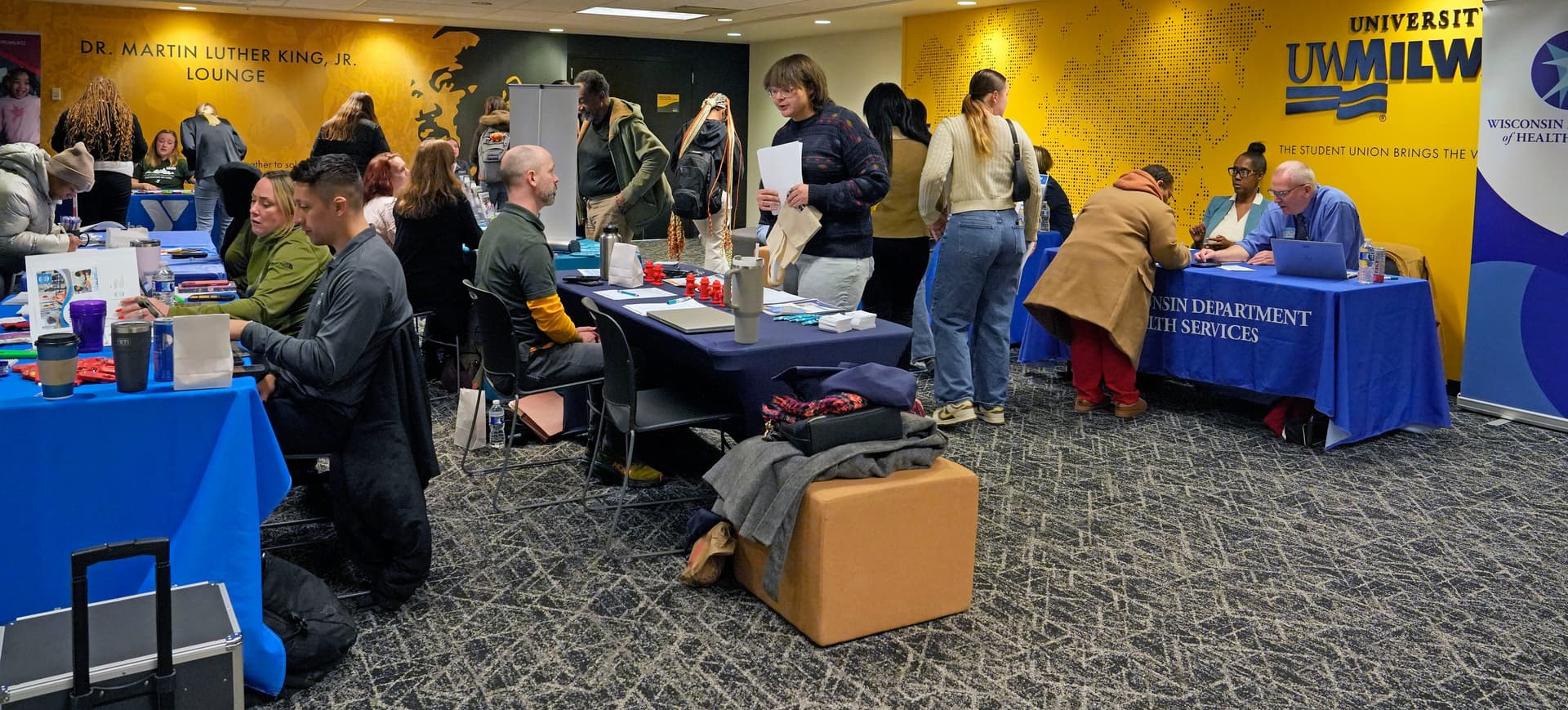
East Seawright, a senior majoring in information science and technology, noticed fewer companies at the software, analytics and IT career fair than in past years. He would know. It was at a career fair Seawright's sophomore year that he landed an internship.
UWM said the software, analytics and IT career fair is still relatively new and has always been smaller than other fairs. There were 13 employers this year, down from 16 last year. But the university said it has seen robust participation at its other on-campus career fairs. The business and communications fair, for example, hosted 68 employers this year. UWM connects students to area employers in other formats, too, including coffee chats, panel discussions, resume reviews and mock interviews.
"UWM offers unparalleled opportunities for preparing graduates for lifelong careers with adaptable skills that go beyond the first job," the university said in a statement.
Seawright still has the internship he found through the career fair two years ago. He hopes it leads to a full-time offer after he graduates this spring.
But just in case, Seawright started applying elsewhere. And he's using AI to "AI-proof" his own materials after reading about how companies are using AI to screen hundreds or thousands of applications. He asked a chatbot to incorporate keywords from a company's job description into his cover letter and resume to increase his chances of making it through the application tracking system.
At UWM career fairs, students say they have applied to many jobs
Several other UWM students walked out of the software, analytics and IT career fair, discouraged by their job searches.
One student who studied data analytics said he had submitted about 35 applications in the past six weeks. Two companies interviewed him, then ceased contact.
Another student who declined to be named, fearing it would further hinder their prospects, said he has unsuccessfully submitted more than 100 applications every semester since sophomore year. Now a senior, he said he may get a master's degree if he can't get a job.
"It's definitely a congested field," he said of his computer science major. "It's not a field where you can just get a degree and get a job. Maybe in 2015 it was."
UWM graduate student Eric Walker is pursuing a master's degree in anthropology and a certificate in geographic information systems, in hopes of working in cultural resource management. He wants to transition to part-time graduate work as he finishes up his thesis – so long as he can find a full-time job.
Walker estimated he had submitted 50 applications since last summer and only heard back from a few. Most were either denials or offers completely unrelated to his field, such as restaurant jobs.
"I've been applying for a minute," he said sarcastically. "It's rough out there. Maybe I'm in the wrong field. Maybe it's the wrong time. But you got to keep trying. My fingers are crossed."
- #jobmarket
- #ai
- #careerdevelopment
- #collegegrads
- #entrylevel
Comments · 0