The Shocking Truth About Women's Career Advancement: Why Companies Are Failing to Close the Opportunity Gap

Companies across the U.S. and Canada are losing their commitment to women’s progress, according to a newly released report from McKinsey and LeanIn.Org. Only half of companies surveyed for the Women in the Workplace report said they are prioritizing women’s career advancement, and 21% said it’s a low or not a priority at all. Researchers noted this is part of a multi-year trend in declining commitment to gender diversity.
The Ambition Gap
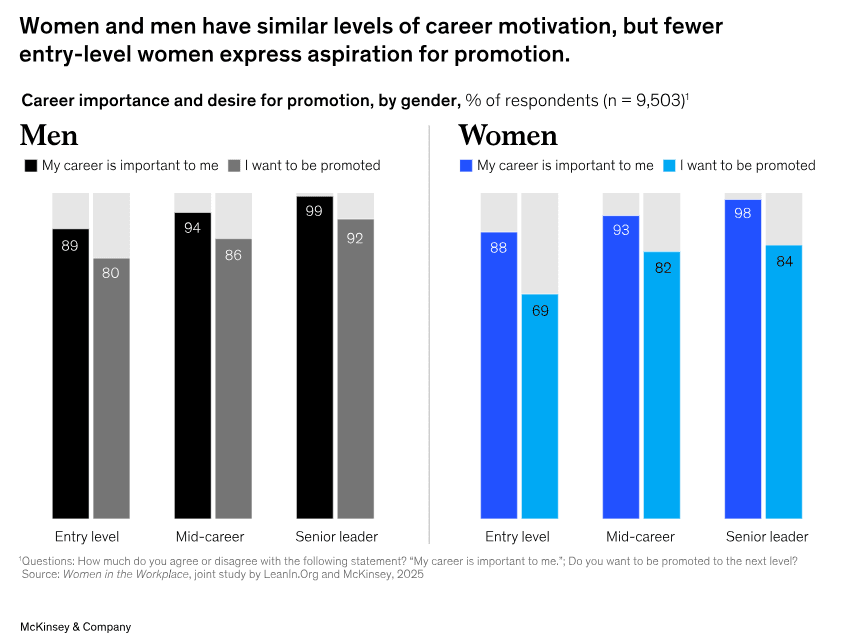
For the first time in over a decade of producing the report, researchers saw a notable gap in ambition. While women and men show equal commitment to their careers and similar motivation to do their best work, 80% of women overall say they want to be promoted to the next level, compared to 86% of men. This gap is most pronounced at opposite ends of the career spectrum:
- 69% of entry-level women want to be promoted, compared to 86% of entry-level men.
- 84% of senior-level women want to be promoted, compared to 92% of senior-level men.
Researchers said this correlates with women not getting the same opportunities as men to advance, as well as a lack of career support.
Opening Doors at the Entry Level
There is tremendous work to be done specifically at the entry level, where an opportunity gap exists. These women are starting their careers with less support and fewer opportunities than their male counterparts. 31% of entry-level women are likely to have a sponsor compared to 45% of men. As the report states:
“Even when entry-level women do have a sponsor, they’re promoted at a lower rate than men.”
As a result, more entry-level men are on a path to a promotion. Four in every 10 entry-level women surveyed have not received a promotion, stretch assignment, or opportunity to participate in leadership or career training in the last two years.
Upskilling and AI Challenges
Today’s workforce is rapidly changing, and women may already be behind. Entry-level women are generally more worried about how the use of AI will affect their jobs. At the same time, they receive less of the support needed to use AI effectively:
Only 21% of entry-level women said they are encouraged by their managers to use AI tools, compared with 33% of men at their level.
When employees are encouraged to use AI, they’re over 50% more likely to do so, allowing them to build essential skills.
Burnout Crisis
Overall, employees faced especially high job insecurity and burnout this year for both women (42%) and men (41%). According to the report, burnout is worse for senior-level women (60%) compared to senior-level men (50%). Nearly eight in 10 women of color at the senior level have been frequently burned out in the past year.
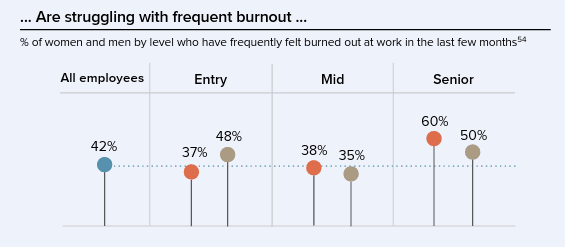
This overall burnout has led to a number of quits, and roughly half of workers surveyed across all levels said they have seriously considered leaving their organizations in the past year.
The Value of a Fair, Inclusive Workplace
Regardless of gender or rank, researchers said employees value bias-free processes and respectful workplaces. Around nine in 10 men and women at all career levels agree that hiring and promotion processes should be free from bias and favoritism and that employees who feel respected and valued are motivated to do their best work. That same group of workers believe a variety of perspectives leads to better decision-making and outcomes.
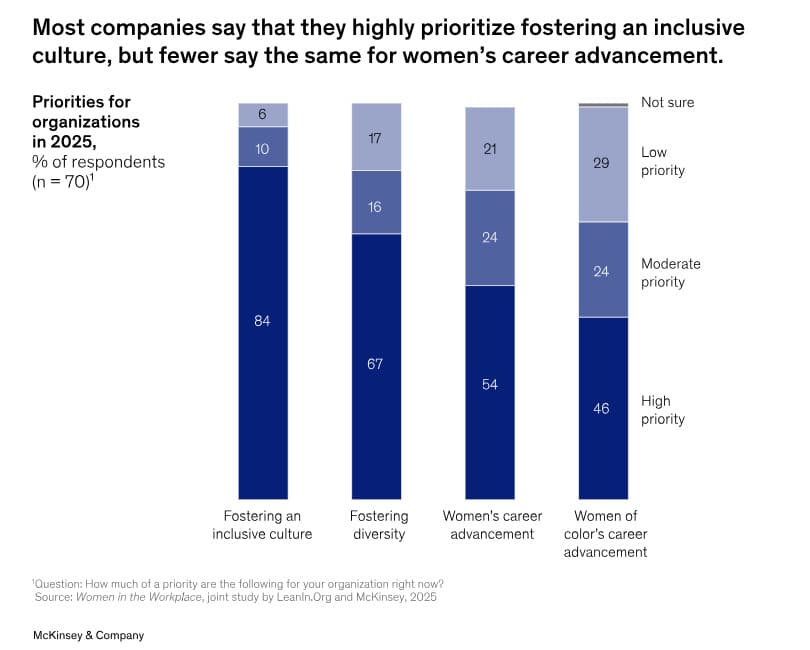
While most companies surveyed—more than eight in 10—remain committed to inclusion, their commitment to women’s advancement is much lower. About half of surveyed companies say women’s career advancement is a high priority, and fewer are prioritizing women of color’s advancement. Researchers noted that companies with more women—and where women’s representation is increasing the fastest—are more likely to place a high priority on supporting women at their organization.
Strategies for Companies
In addition to its findings, researchers published strategies for companies to help leaders create opportunities:
- Ensure hiring and promotions are fair. Hiring and promotions are the main levers of advancement, and when these processes aren’t fair, companies miss out.
- Equip managers to support career development. Freeing managers from routine tasks, setting clear expectations for their regular career check-ins, building capabilities to make them effective coaches, and equipping them with tools enable managers to effectively dedicate more time to their direct reports’ career development.
- Foster authentic sponsorship. Authentic sponsorship goes beyond formal matching programs; it’s about leaders who actively advocate for talent, open doors to new opportunities, and invest in the growth of others.
- Articulate a positive vision of an inclusive culture. Inclusion reflects how much people feel supported and how meaningfully they can contribute. Inclusion starts with a clear, well-communicated vision backed by concrete actions.
- Strengthen employee resource groups to foster community and empathy. Since women tend to have less access to senior-level networks and manager career support, the career advice and practical support offered by employee resource groups can help to level the playing field.
- Activate employees to create inclusion day to day. Small, everyday actions—such as inviting new perspectives, calling out disrespect, and showing empathy—can spark big change, driving stronger collaboration and smarter decisions.
- #women
- #career
- #advancement
- #inclusion
- #burnout
Comments · 0