Why Hiring Is Down But Ad Costs Are Up: The Surprising 2026 Job Market Trend
The Counterintuitive Labor Market Shift
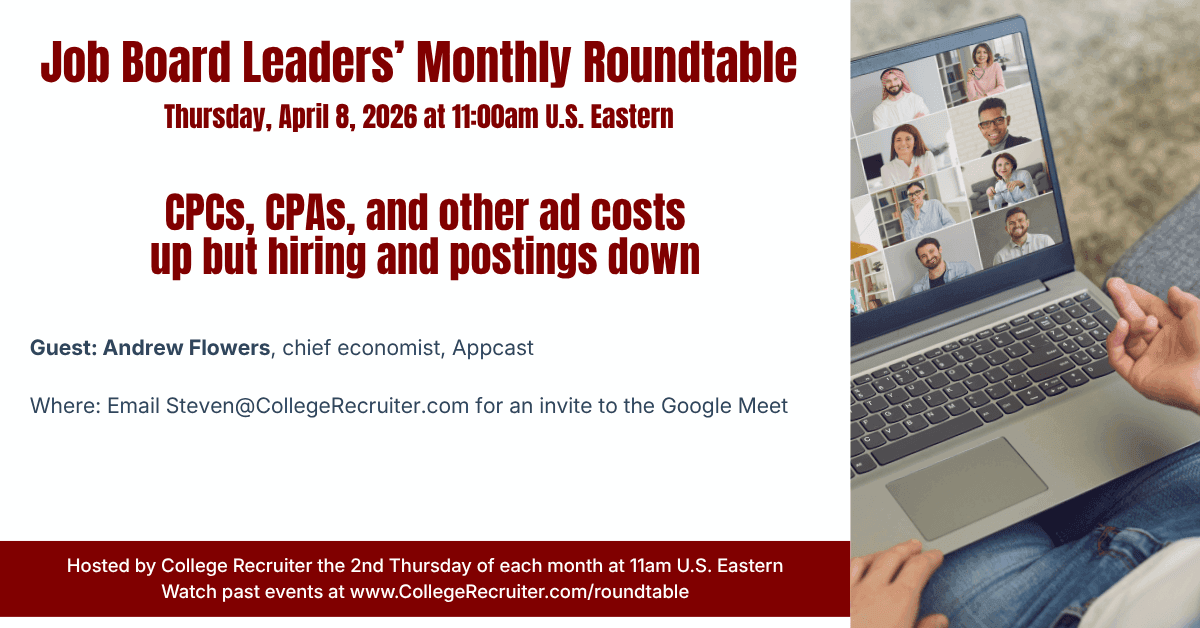
In April 2026, Andrew Flowers, chief economist of AppCast, Inc., presented startling data at the Job Board Leaders' Monthly Roundtable. Despite hiring declining in 2025, advertising costs for job postings increased by about 22%—a paradox that reveals deeper shifts in recruitment strategies.
Understanding AppCast's Data
AppCast, founded in 2014, is the leading recruitment marketing platform globally and the largest buyer of job advertisements on major boards like Indeed, ZipRecruiter, and LinkedIn. Their data covers hundreds of millions of job ads, millions of employers, and thousands of job boards across dozens of countries.
The US Labor Market Softening
In 2025, the US labor market softened significantly:
- Hiring declined and became more favorable for employers
- The ratio of job openings to unemployed people cooled from 2:1 to 0.909
- Indeed job postings declined by 16% over two years leading to January 2024
This created a "low hire, low fire" economy—not a recession with massive layoffs, but a period of slow hiring that made job searching particularly challenging.
The Recruitment Marketing Paradox
Despite the hiring slowdown, recruitment marketing metrics showed surprising increases:
- Cost per click (CPC) rose by 22% in 2025
- Cost per application (CPA) increased for certain occupations
The Scarcity Game: Why Costs Increased
The explanation lies in employers shifting their advertising strategies:
- Programmatic spend concentrated on hard-to-fill roles like healthcare, education, and science/engineering
- Organic channels used for easier-to-fill white-collar positions
- Healthcare application costs reached $35 per application while other occupational groups saw declines
Highest Cost Occupations
The occupational groups with the highest CPAs were:
- Healthcare (non-automatable, in-person service delivery)
- Education (teachers and administrators)
- Science and engineering (including AI-related roles like data scientists)
Job Seeker Behavior Changes
Conversion rates revealed interesting patterns:
- White-collar fields (legal, technology, finance, consulting) saw the biggest jump in applicants
- Job seekers in these roles showed fear of job security and used mass AI tools to apply
- Declining conversion rates in healthcare, hospitality, transportation, and education
Global Variations
International data showed significant regional differences:
- Germany, Austria, and Poland showed big declines in CPA
- United Kingdom held steady
- The labor market story is not uniform across countries
Early Career Hiring Challenges
Gerry Crispin raised concerns about the extreme slowdown in hiring for early career candidates. Andrew Flowers identified four key factors:
- Macroeconomic factors like high interest rates disproportionately affect young people
- Lack of turnover (the "great hug") prevents new hires
- AI impact on highly exposed occupations (finance, software development)
- Booming opportunities in AI-unexposed jobs (physical therapy, teaching, skilled trades)
Future Competition for Job Boards
Ben Groves questioned whether spend is moving from job boards to other sources. Key insights emerged:
- Search/social channels complement job boards for niche roles or Gen Z workers
- Large language models (LLMs) represent the existential long-term threat
- While not immediate for 2026, LLMs could significantly disrupt job search by 2030
Key Takeaways for Job Seekers and Employers
The job market has shifted from volume-based hiring to scarcity-based recruitment. Employers now focus advertising dollars on hard-to-fill, specialized roles while using organic methods for more common positions. For job seekers, this means opportunities vary dramatically by occupation and location, with some fields becoming more competitive while others face talent shortages.
- #jobmarket
- #recruitment
- #careertrends
- #hiring
- #labor
Comments · 0