

Entry-level jobs once served as the first step on the career ladder, allowing young adults to learn, contribute, and earn a living as they transitioned from college to professional life. Today, that rung is disappearing, replaced by internships that often fail to provide meaningful experience or fair compensation.
The shift from entry-level jobs to internships is subtle but significant. Many supposed entry-level roles are now offered as internships or require applicants to already have years of work experience. This creates a paradox where employers expect students and graduates to have experience before they can gain any.
Data from 2023 and 2024 shows that only 60% of internships in the United States are paid. What was once an accessible launch point has become a gated system where only those who can afford to work with little or no pay can participate.
The gap between promise and reality in internships is stark. In theory, internships are designed to provide hands-on learning, mentorship, and exposure to a workplace environment. In practice, many interns find themselves relegated to low-skill, administrative tasks — busywork that 70% of hiring managers believe could be done by artificial intelligence. While these tasks may offer a glimpse into professional operations, they rarely build the substantive skills that employers later demand.
The primary driver behind this trend is cost. By relying on underpaid interns, companies can reduce labor expenses while still maintaining productivity. Formerly compensated entry-level work is now outsourced to a rotating pool of temporary, disposable workers. Only around 50% of interns in the U.S. become full-time employees upon completing their internship.
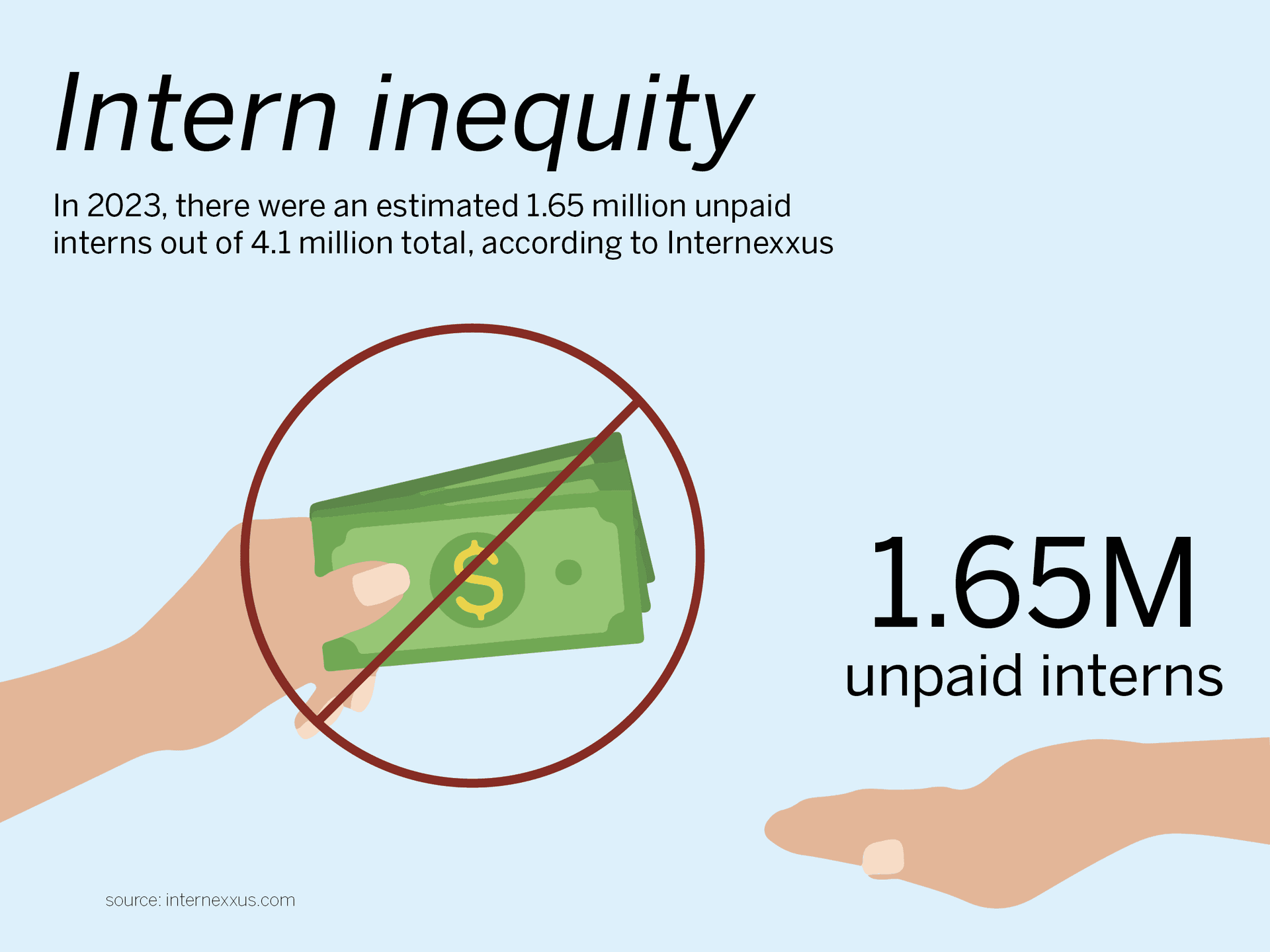
The internship model exacerbates inequality among college students. For those with financial support from family, accepting a low-paying or unpaid internship may be feasible. For others, it’s simply not an option. Students who need to earn money to pay for student loans, housing, or basic necessities can’t afford to spend a summer — or an entire semester — working for free.
Students who can afford internships gain the credentials required for full-time roles, while those who can’t are left behind, regardless of their talent or work ethic. By the time hiring decisions are made, this disparity is clear. Employers interpret this lack of internship as a lack of initiative, rather than a reflection of economic reality.
The internship economy distorts what experience means. Instead of signaling capability, experience has become a checkbox — something to accumulate rather than a reflection of actual skill. Employers and educators encourage students to stack multiple internships, sometimes across entirely different fields. This isn’t because each one builds expertise, but because each added line on your resume boosts your marketability. The result is a generation of applicants who appear experienced on paper but have had little opportunity to develop depth in any one role.
Internships are no longer confined to summers; many students now juggle part-time internships alongside full course loads, extracurriculars, and, for some, paying jobs. Many universities even require students to meet a certain number of internship hours to graduate. Syracuse University’s Whitman School of Management requires a minimum of 120 internship hours for undergraduates.
Unlike traditional entry-level roles, which begin after graduation and provide stability, internships often demand professional commitment without proper compensation or security. Students who intern during the academic year are effectively working two jobs — one they pay for, and one that’s supposed to “pay off” later.
The irony is that most college students and recent graduates are already capable of contributing meaningfully in true entry-level roles. They have completed coursework, developed critical thinking skills, and often held part-time jobs that require responsibility and adaptability. Yet, instead of being trusted with real work and fair pay, they’re funneled into positions that neither challenge nor compensate them.
If the goal is to prepare young adults for the workforce, the current system is failing. Internships should supplement — not replace — entry-level jobs. They should offer structured training, mentorship, and pay that reflects the value of the work being performed. Most importantly, they should be accessible to all students, not just those who can afford to participate.
Reversing this trend will require structural and cultural change. Employers must reevaluate their reliance on internships as a substitute for paid labor and invest in entry-level positions that provide valuable experience. Universities, too, should be more critical of internship pipelines that exploit students under the guise of professional development.
The transition from college to career shouldn’t be designed to filter out those without financial safety nets. It should be a bridge that allows all students to step into the workforce with dignity, experience, and the opportunity to succeed. Right now, that bridge is crumbling. It’s time to rebuild it.



Comments
No comments yet
Be the first to share your thoughts and start the conversation!